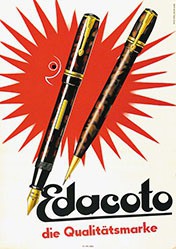
About reverse-sided times
A discussion with Donald Brun, creator of posters an exhibition stands in the years 1933 to 1974 puts us back to the time before the photo-lithography and the offset print.
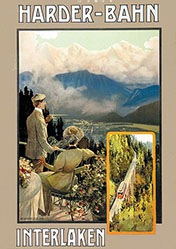
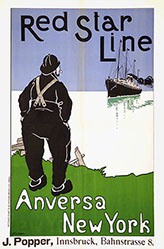
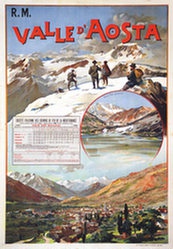
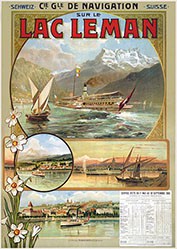
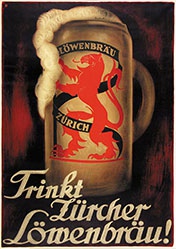
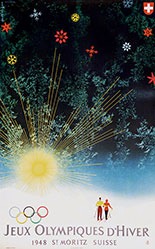
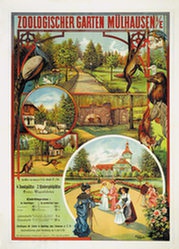
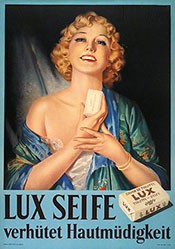
According to the then printing process – stone print – the artist’s clean proof was transmitted by the stone printer reverse-sided on to the litho-stones. One stone was required per colour.
Donald Brun cannot remember the weight of each single stone. He only recalls that it took four men to lift the stones. It is too long ago!
But even today he is convinced that the best photo-lithography never reaches the strength of colours in “stone print times”
Who is Donald Brun really?
Donald Brun was born in Basel in 1909. From 1927 to 1930 he was able to complete an apprenticeship as “advertising draughtsman” with Ernst Keiser, one of the first Swiss professional graphic artists. He well remembers his first challenge during his apprenticeship: the poster competition of the City of Basel for a “spa poster”. His suggestion was chosen and he tells about the first contract with “his” spa poster as follows:
“You ought to know that in those days advertisements were painted on to the open fire – proof walls of buildings, the so-called gable wall advertisements. Thus, one day in 1928, or it may well have been in 1929, I took a ride in a Basel tramway. Suddenly I noticed that “my spa poster” was painted on a wall , approximately 30m high and correspondingly wide. The tramway driver, next to whom I was standing, also saw it for the first time and said: “If we had done this formerly, our backside would have been spanked”….
In spite of my own astonishment I disclosed to him with no hesitation that I made this poster. I shall never forget his doubting surprise and his following misgiving.”
Donald Brun’s “apprentice work” was the prelude to a successful independent profession as graphic artist, lasting some 50 years. During this time many of his posters were awarded as being exemplary. And yet he never followed the same routine. He seized every assignement anew. Among his clients were such renowned organisations as the Swiss Federal Railways, Swissair, the Swiss Fair in Basel, Henkel and many more. In the forties his “Persil Gritli poster” was one of the most famous advertisements of the kind.
“Ofter the concept for the poster developed in my mind already during the conversation with the client. I sketched it on the spot and explained to him how I imagined it. Form the expression in his face, from his reactions, I was able to see whether my idea was right or wrong. Naturally, it was not always that easy. It could even take days until I found the rousing notion. During the presentation of my suggestions – of course, I was always totally convinced by them – it took a lot of “mouth work” and persuasive power in order to obtain the OK for the realisation”.
What was the meaning of “realisation” in those days – i.e. before the photo lithogaphy? Donald Brun had to submit his idea to the stone printer as a clean proof in world size. Then the latter transmitted the entire work on to the litho stones again in reverse side. Remember that each colour required a stone. Very often 8 stones (for 8 colours) were required. This produced these strong colours which – as Donald Brun is convinced – cannot be attained with any other photo lithography.
Now Donald Burn enjoys his retirement in Montreux. The “reverse sided times” are now just a memory. However, they may remind each viewer or collector what it means when a poster bearing the notice “stone print” is in front of him or is perhaps his property
|